There is a ferry to Ilha de Tavira, said Marianne. A ferry?
The word elicited an immediate response in me—a curiosity, an invitation and a childlike thrill.
Whether a short commute across the Boston Harbor, a night sailing from Marseille to Corsica, or a wind-swept passage to reach the Hebrides from the Scottish Highlands, ferries transport bodies and hearts.
The traveler leaves the firm ground to give themselves into the care of the captain of a vessel and surrender their fate to the water.
We find these stories in mythology, fairytales, literature and modern-day travel blogs – they endure.
Marianne had given me directions to the ferry in Tavira and recommendations on a possible return route along the salt pans, where pink flamingos gather, which I wanted to take.
Estuary landscapes speak to me, as my maternal grandfather came from Arles in the Camargue region of Southern France, where the wide delta of the Rhône River reaches the Mediterranean. Perhaps we are drawn to transition places in the landscape, such as where a river meets the sea. With their changing light, migrating birds, fragile flora and the stories of their people, they hold our attention and invite daydreaming.
As a child, I regularly visited the salt flats and rice fields of Camargue. There, Van Gogh painted starry nights, gypsies sang to the black Madonna, and colorful “guardians” herded black bulls on white horses.
“Salt of the earth” is a biblical reference to the good and best among us. It came from a time when salt was precious, and people worth their weight in salt were held in great esteem. Tavira, a historic fishing village with a now-defunct salt industry and abandoned factories, still produces salt from the Ria Formosa flats. Sadly, microplastics are now altering the quality of its salt.
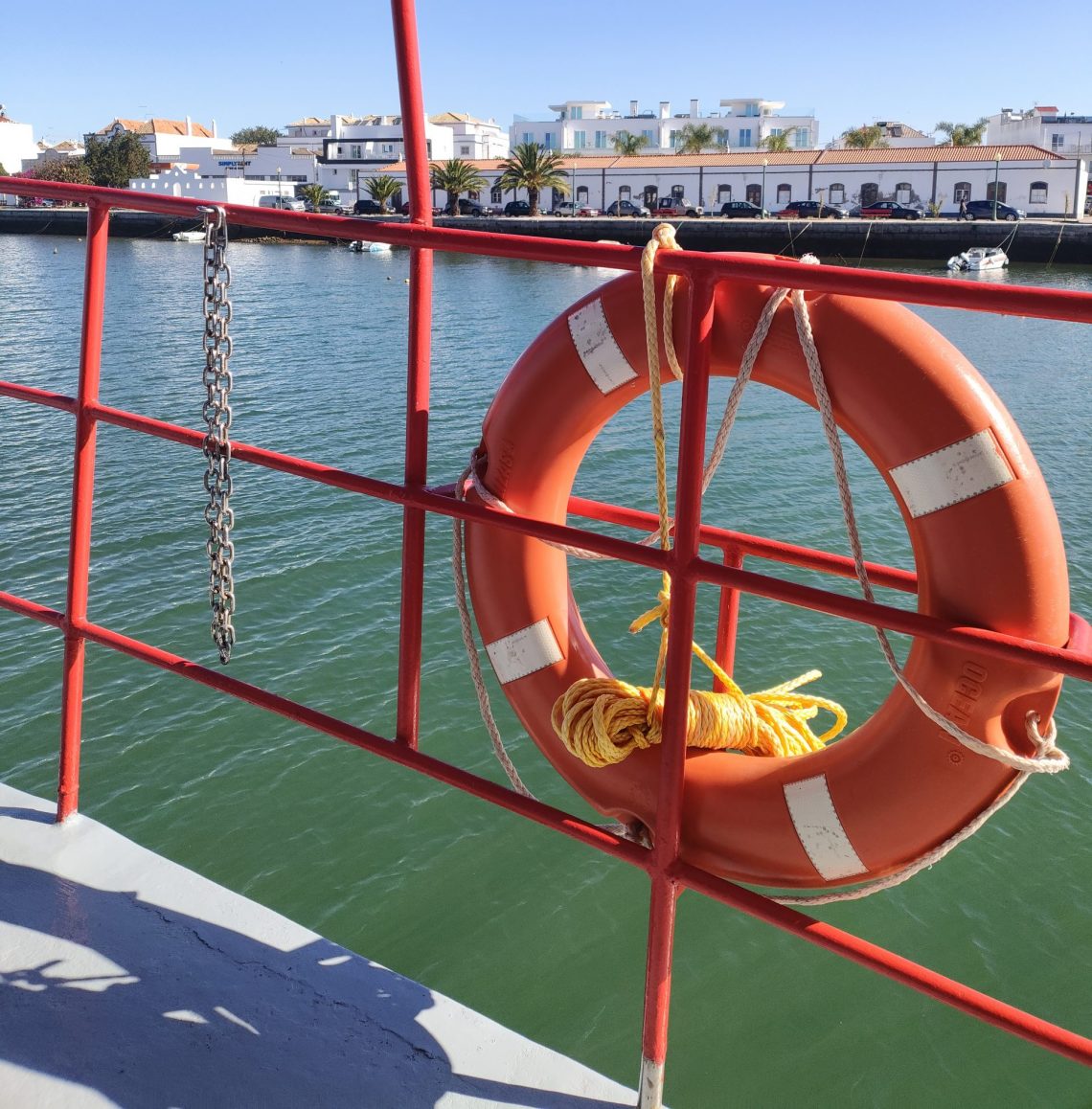
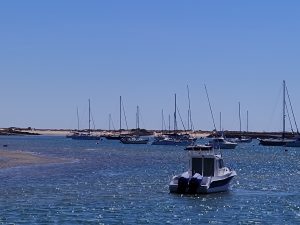
So, on Wednesday morning, I took the 9:30 ferry from Tavira to the Parque Natural da Ria Formosa, a 20-minute ride sitting next to an animated group of women hiking from Porto to the Spanish border. After a week of rain, they were looking forward to a day of R&R on the beach. A fellow writer was also on board but, unable to walk with an injured foot, left on the returning ferry.
I walked across the sand to the seaside restaurants, the neatly lined umbrellas and sunbeds not quite set up. When I reached the water, I removed my shoes, greeted the mighty Atlantic with a silent prayer of thanksgiving, and stayed a while. Then, deciding to keep out of the glaring sun, I returned to town on the 11:15 ferry to inquire about the salt pans at the tourist office, have a meal and call Sue to pick me up in the afternoon as planned.
Well, nothing went as planned. The tourist office had no information on the salt flats, “it’s online, Madame. It’s all online.”
That is when my phone went dead.
I pressed the ON button repeatedly, with increasing insistence, to no avail.
One woman offered to help with a charger and went to a back room to find the right kind, but my phone was unresponsive. Then someone suggested the nearby cyber café where I could send an email.
The café at the corner of a quiet street had three computers lined against a wall, three dark screens in sleep mode. A man behind the counter was on the phone, listening intently to instructions about what seemed to be a technical challenge. The matter was of importance because he ignored me for a long time, and I was getting anxious, silently listing my options to reach Sue.
I couldn’t remember any of my passwords to log in to my inbox or Facebook. I didn’t know Sue’s or Stephen’s email addresses, and I had no way to text, call or receive a validation code on my phone, since it still wasn’t responding.
When Santiago finally turned his attention to me, I had several requests. Possibly unreasonable requests. He said yes to all of them.
Signing in to the café’s email account, I entered several made-up addresses for my hosts, but they all bounced as undeliverable. Then I asked to log in to Santiago’s FB account because mine couldn’t be verified.
From there, I sent bottles-out-to-sea-type messages, thinking there was little chance people would open a link from a total stranger with a funny picture on Facebook. But I made sure to announce, “Francoise here. Please read.”
At each step, Santiago was patient and helpful. Finally, my last request was, ” Could you please call me a cab?”
More relaxed, we waited, chatting about the feral cats he feeds, and he thanked me for my donation to the tip jar, which goes toward cat food.
The taxi arrived – relieved and on my way – I waved, even threw him kisses. Now I wonder how many stranded travelers – grateful for the kindness of a stranger – Santiago has rescued to date.
As for me, I had met the salt of the earth in a small corner of the Algarve.
PS: I didn’t have my host’s address, but I knew the general direction out of town. Relying on my sense of direction, I gave the taxi driver enough cues to get back. And just in time! They were beginning to wonder if a search party was in order:)
. “Traveling forces you to trust strangers and to lose sight of all the familiar comforts of home and friends. You are constantly off balance. Nothing is yours except the essential things — air, sleep, dreams, the sea, the sky. All things tending towards the eternal or what we imagine of it.” – Cesare Pavese
Dear Françoise
I feel, despite the hiccup with your phone, or maybe because of it, you were in your element.
I want to hear more about the writing retreat.
And yes, the new picture surrounding Words to Evolve is very lovely.
Happy travels to you and your blog,
love,
Valérie
Thank you for your comments, dear Valérie.
I did enjoy the day, the adventure and the writing that followed.
Travel writing is a specific genre with its rules and codes. Journalists and explorers have a head start on the rest of us.
One of our instructors, Stephen Powell, is a retired journalist and has written several travel books. I am currently reading the compelling account of his travels in the South Caucasus: The First Toast is to Peace.
I may suggest a Travel Writing workshop to GWG; people seem interested.
Nice piece of writing. I especially liked the very full look at what writing a ferry can mean. Your adventure sounds adventurous, but anxiety provoking too. It reminds me to carry on a piece of paper some key information that I won’t necessarily remember. Our computers do us a disservice that way, pressing a button is not the same thing as remembering something. Thanks for sending it to me.
Dear Erika
How nice to read your comments. Thanks.
You are so right about having a small notebook with key info when we are traveling. I have one but left without it, I didn’t even have the address of the place I was staying at. Luckily, I gave the taxi driver enough cues to make it back. And just in time! They were beginning to wonder if a search party was in order:)
Take good care
Françoise
Dear Françoise,
How lovely to go to Tavira with or without phone! How wonderful that you remain so curious and adventurous. I’ve not been to Tavira, but my relatives speak highly of the place, and clearly at least Santiago is kind and patient! I remember seeing the salt flats whenever I crossed the Tejo. Today, I see people clamming. I’m not sure where the salt went! Your photos are beautiful too!
Best,
Laurie
Dear Laurie,
I’m so glad you enjoyed the story of my day in Tavira. An adventure with a happy ending, Santiago was lovely. It is my second visit to Portugal and I keep meeting wonderful people. Are you going soon? I hope you and the family are doing well. My best to Lano and Jacqueline.
Françoise
The kindness of strangers: that’s what sings to me from this piece. Today, with all the complications of the world, I am so touched by the idea that this man, this stranger, would say yes to all of your requests, even if they might have been “unreasonable.” You were bold to go on this trip, and fearless to face all of the challenges thrown at you, and your rewarded by his response to you! Bravo. I’m glad to have read about it.
Dear Lynn,
Thank you for reading and commenting on my story.
I believe that Salt of the Earth people are everywhere, and sometimes we are lucky enough to meet one. That day, I asked for help, and a stranger responded with kindness.
It was that simple.
Take good care
Françoise
Wow! Your beautiful writing continues to dazzle. And you landed on both feet in this very tricky situation. Wonderful.
We are wired to these networks now–it happened just slowly enough, and completely enough, that we don’t remain aware of how the Internet and the cell towers both support and own us. (Is that too extreme? Maybe not extreme enough?)*
I am reminded of something that happened when we vacationed at the Florida Everglades a few years ago. I was on a houseboat where we had no cell service for nearly two days. We had no crises, and were in no danger, except for my rising anxiety as I reflexively reached for the phone again and again, only to realize that it was useless.
Late in the first day, I had a moment of empathy with the bees who fly a small area (less than a square mile) looking for pollen and nectar during their short adult lives (less than 3 weeks). I thought of the moment when they arrive to find concrete newly installed where their ancestors once foraged. Bees pass along directions to their descendants.
If bees can feel panic, this would be the moment.
It reminded me to think about the need for a backup. And it reminded me of the importance of planting for the bees, as much and in as many places as I can.
*When Paul travels to the Canadian wilderness, he takes two cell phones and a satellite phone.
Thank you for your comments, Kathy.
I agree that this adventure raises awareness of our dependence on tech. Does Paul really need two cell phones and a satellite phone in the wilderness? I will take an extra cell phone next time, along with a sheet of paper with key info.
And, yes! to bees and trees!


11 Comments
Patricia
Oh, My God! What an adventurous day!
Valérie
Dear Françoise
I feel, despite the hiccup with your phone, or maybe because of it, you were in your element.
I want to hear more about the writing retreat.
And yes, the new picture surrounding Words to Evolve is very lovely.
Happy travels to you and your blog,
love,
Valérie
Françoise Ducroz
Thank you for your comments, dear Valérie.
I did enjoy the day, the adventure and the writing that followed.
Travel writing is a specific genre with its rules and codes. Journalists and explorers have a head start on the rest of us.
One of our instructors, Stephen Powell, is a retired journalist and has written several travel books. I am currently reading the compelling account of his travels in the South Caucasus: The First Toast is to Peace.
I may suggest a Travel Writing workshop to GWG; people seem interested.
Erika Keller Rogoff
Nice piece of writing. I especially liked the very full look at what writing a ferry can mean. Your adventure sounds adventurous, but anxiety provoking too. It reminds me to carry on a piece of paper some key information that I won’t necessarily remember. Our computers do us a disservice that way, pressing a button is not the same thing as remembering something. Thanks for sending it to me.
Françoise Ducroz
Dear Erika
How nice to read your comments. Thanks.
You are so right about having a small notebook with key info when we are traveling. I have one but left without it, I didn’t even have the address of the place I was staying at. Luckily, I gave the taxi driver enough cues to make it back. And just in time! They were beginning to wonder if a search party was in order:)
Take good care
Françoise
Laurie Zucker-Conde
Dear Françoise,
How lovely to go to Tavira with or without phone! How wonderful that you remain so curious and adventurous. I’ve not been to Tavira, but my relatives speak highly of the place, and clearly at least Santiago is kind and patient! I remember seeing the salt flats whenever I crossed the Tejo. Today, I see people clamming. I’m not sure where the salt went! Your photos are beautiful too!
Best,
Laurie
Françoise Ducroz
Dear Laurie,
I’m so glad you enjoyed the story of my day in Tavira. An adventure with a happy ending, Santiago was lovely. It is my second visit to Portugal and I keep meeting wonderful people. Are you going soon? I hope you and the family are doing well. My best to Lano and Jacqueline.
Françoise
Lynn Barclay
The kindness of strangers: that’s what sings to me from this piece. Today, with all the complications of the world, I am so touched by the idea that this man, this stranger, would say yes to all of your requests, even if they might have been “unreasonable.” You were bold to go on this trip, and fearless to face all of the challenges thrown at you, and your rewarded by his response to you! Bravo. I’m glad to have read about it.
Françoise Ducroz
Dear Lynn,
Thank you for reading and commenting on my story.
I believe that Salt of the Earth people are everywhere, and sometimes we are lucky enough to meet one. That day, I asked for help, and a stranger responded with kindness.
It was that simple.
Take good care
Françoise
Kathy Connolly
Wow! Your beautiful writing continues to dazzle. And you landed on both feet in this very tricky situation. Wonderful.
We are wired to these networks now–it happened just slowly enough, and completely enough, that we don’t remain aware of how the Internet and the cell towers both support and own us. (Is that too extreme? Maybe not extreme enough?)*
I am reminded of something that happened when we vacationed at the Florida Everglades a few years ago. I was on a houseboat where we had no cell service for nearly two days. We had no crises, and were in no danger, except for my rising anxiety as I reflexively reached for the phone again and again, only to realize that it was useless.
Late in the first day, I had a moment of empathy with the bees who fly a small area (less than a square mile) looking for pollen and nectar during their short adult lives (less than 3 weeks). I thought of the moment when they arrive to find concrete newly installed where their ancestors once foraged. Bees pass along directions to their descendants.
If bees can feel panic, this would be the moment.
It reminded me to think about the need for a backup. And it reminded me of the importance of planting for the bees, as much and in as many places as I can.
*When Paul travels to the Canadian wilderness, he takes two cell phones and a satellite phone.
Françoise Ducroz
Thank you for your comments, Kathy.
I agree that this adventure raises awareness of our dependence on tech. Does Paul really need two cell phones and a satellite phone in the wilderness? I will take an extra cell phone next time, along with a sheet of paper with key info.
And, yes! to bees and trees!